
CO2 footprint calculator: measure & reduce emissions
What your invisible climate footprint reveals about you

Think of your carbon footprint as the invisible trail you leave in the snow on a winter walk. A CO2 footprint calculator makes this trail visible. It works like a digital sniffer dog that scrutinizes all your daily activities and determines their impact on the climate.
From everyday life to the climate puzzle
Your morning cup of coffee, your warm home, your commute to work – all these seemingly small things affect your ecological footprint. The CO2 footprint calculator sheds light on this and shows you how your lifestyle affects the environment. Basically, it’s about understanding each individual’s contribution to the greenhouse effect and identifying ways to reduce emissions. In Germany, the average greenhouse gas footprint per capita in 2024 was around 10.3 tons of CO2 equivalents. You can find more information on the greenhouse gas footprint per capita here. This figure illustrates how important each individual is for climate protection.
More than just numbers: Your personal climate coach
A CO2 calculator is not just a dry calculation tool. Rather, it is your personal climate coach that helps you to understand and reduce your impact on the climate. The detailed breakdown of your emissions shows you in which areas of your life you have the greatest influence.
Understanding decisions and their consequences
You can use the calculator to play through various scenarios – like a “what if” game. What happens if you use your bike more often instead of your car? How would your carbon footprint change if you reduced your meat consumption? The calculator provides you with the answers and helps you to make conscious decisions for a more sustainable lifestyle.
The CO2 footprint calculator thus becomes a valuable companion on your way to a more climate-friendly life. It enables you to actively take responsibility and make a contribution to climate protection. And with your newly acquired knowledge, you can not only reduce your own footprint, but also sensitize others to the issue.
The science behind the CO2 figures: A look behind the scenes
Imagine you enter your data into a CO2 footprint calculator – your heating habits, your air travel, your everyday life. But how does this become a concrete CO2 figure? It’s not magic, but a fascinating interplay of science and technology. The calculator acts like a translator, converting your data into the language of climate protection: CO2 equivalents.
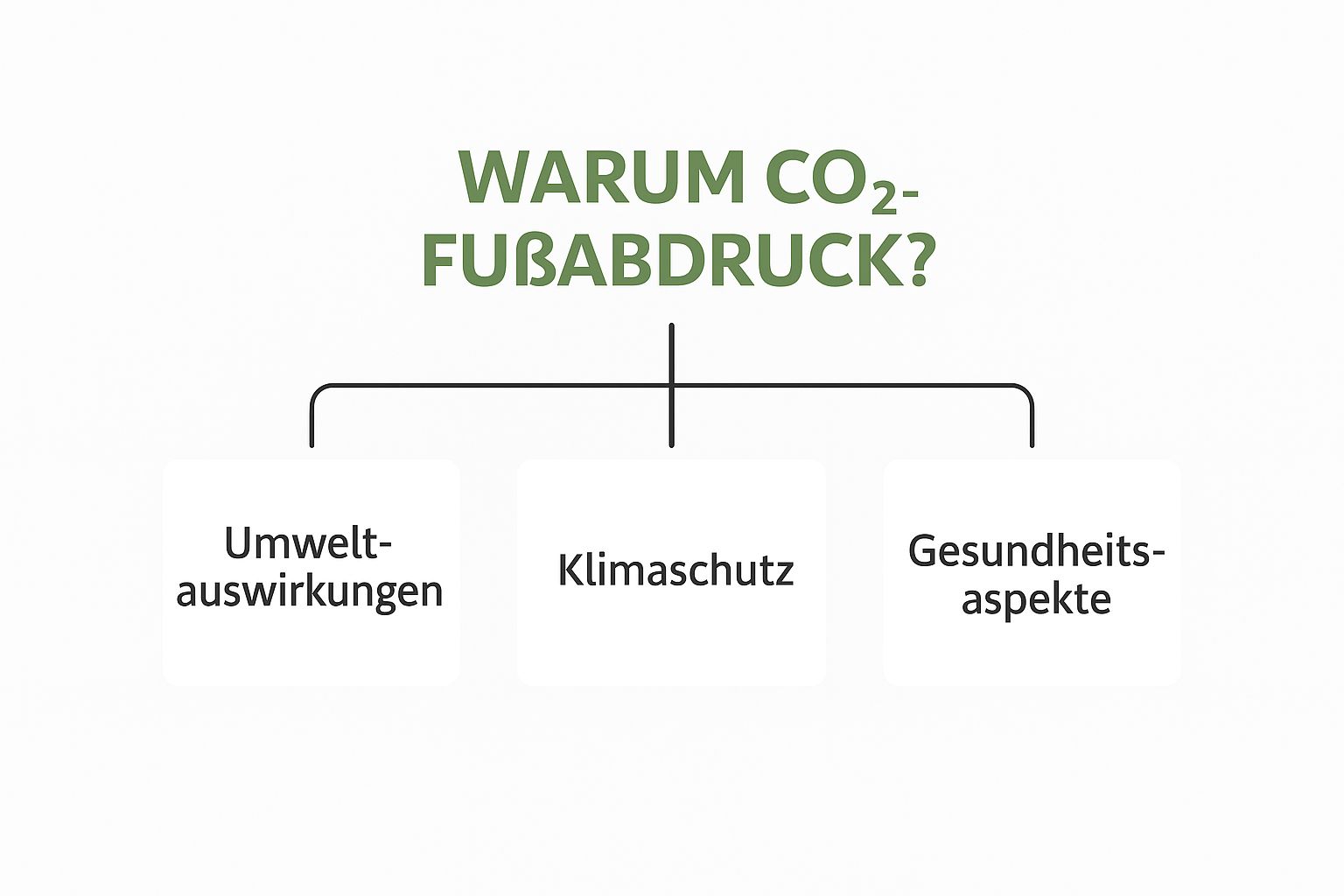
The infographic clearly shows that calculating the carbon footprint has far-reaching positive effects: from environmental and climate protection to health aspects. This underlines the importance of this topic for all of us. You can find out more about the CO2 footprint here: My CO2 footprint.
From input to calculation: how are the results generated?
Sophisticated calculation models work behind the scenes, fed by huge emissions databases. Imagine these databases as a comprehensive encyclopaedia of CO2 emissions. They contain information on how much CO2 is emitted during the production of a liter of milk, for example, or the emissions caused by a flight from Munich to Berlin.
Algorithms: The silent masters of calculation
This data is linked to your personal entries – and this is where the algorithms come into play. They are the silent masters of calculation in the background. You could compare them to a chef searching a huge recipe book (the database) for the right ingredients – the emission factors – for your individual dish. The algorithm uses these ingredients to calculate your personal CO2 footprint.
Why different calculators deliver different results
As with cooking, the CO2 footprint depends on the ingredients and the recipe. The accuracy of a calculator depends on the completeness of the databases and the complexity of the algorithms. For example, does a calculator take into account regional differences in electricity generation? Such factors can lead to different results with different CO2 calculators.
To give you a better overview, we have created a comparison table:
Comparison of different CO2 footprint calculators
Overview of the most important CO2 calculators available with their strengths, focus areas and level of detail
| Calculator | Areas covered | Level of detail | Special features |
|---|---|---|---|
| Example calculator A | Food, mobility, housing | Medium | Takes regional electricity mixes into account |
| Example calculator B | Consumption, travel, energy | High | Detailed product database |
| Example calculator C | Mobility, Housing | Low | Focus on simple calculation |
Note: This is a sample table. The information may vary depending on the available computers.
The table shows that each calculator has a different focus. It is therefore worth comparing them to find the right calculator for your needs.
The interpretation of the results: More than just a number
Understanding the scientific principles will help you to classify the results correctly. It’s not just about the number itself, but about understanding the correlations. What influences my CO2 footprint the most? Where can I take effective action to reduce it? Only with this knowledge can you take targeted measures and make a positive contribution to climate protection.
Detect the hidden climate sinners in your everyday life
You are currently viewing a placeholder content from YouTube. To access the actual content, click the button below. Please note that doing so will share data with third-party providers.
More InformationImagine that your biggest contribution to climate change does not come from flying or driving, but is hidden in your everyday life. Like a detective who finds hidden clues, a CO2 footprint calculator can uncover these surprising climate sinners. After all, it is often the small, everyday habits that add up unnoticed to a considerable carbon footprint.
Morning coffee and a warm shower: small moments, big impact
A warm shower in the morning, a fragrant cup of coffee, a cozy evening in front of the TV – all nice moments, but they leave an ecological footprint. The CO2 footprint calculator reveals how these seemingly small moments affect our energy consumption and therefore our CO2 emissions. Let’s take coffee: from growing and transporting the beans to heating the water and disposing of the coffee grounds – all of this is taken into account.
This will give you a much more accurate picture of your actual influence.
From shopping baskets to vacation destinations: focus on consumption and leisure
In addition to our daily routines, our consumption decisions and leisure activities play an important role. What ends up in our shopping basket? What do we eat? How do we spend our free time? All of this influences our CO2 footprint. The calculator shows, for example, how regional food affects our carbon footprint compared to imported products or whether taking the train is not more climate-friendly than flying on vacation. Speaking of sustainability: you can find out more about this important topic in our article on examples of ESG measures.
Recognize your own emission drivers: The path to change
With a CO2 footprint calculator, you can analyze various areas of your life and get a clear picture of your personal emission drivers. This is the first step towards targeted measures to reduce your carbon footprint. You may discover patterns that you were previously unaware of and can thus set priorities for climate-friendly action. After all, we can only make an effective contribution to climate protection if we know where to start. It is often small adjustments in everyday life that make a big difference – switching to green electricity, eating less meat on your plate or making a conscious choice of transport.
Successfully mastering your first climate check
Let’s get started with your first CO2 check! Imagine you are packing your rucksack for a hike. You need provisions and a map. It’s similar here: We guide you step by step through the preparation, data entry and evaluation of the results.
The right preparation: Gathering information
Before you use a carbon footprint calculator, it is good to have some information to hand. Collect data on your energy consumption (electricity, gas, heating oil), your travel habits (car, train, plane) and your consumption (food, clothing).
Don’t have all the details in your head? Don’t worry, estimates are perfectly fine. The important thing is to be honest and not gloss over anything.
Data entry: Even rough estimates help
CO2 calculators are generally designed to be user-friendly. You are guided through various areas and asked specific questions. Enter the data you have collected here.
Are you unsure? Then enter an estimate rather than leaving the field blank. You don’t know exactly how many kilometers you drove by car last year? Think about how often you drive per week and how long the distances are on average. This will give you a realistic figure.
Mastering tricky areas: sporadic activities and seasonal differences
Some activities are not so easy to categorize. What about the occasional weekend trip or the seasonal fluctuations in heating? Most calculators offer additional input fields here.
You can often specify the frequency and duration of such activities. This allows your CO2 footprint to be calculated even more precisely.
Interpreting the results: What the numbers mean
After entering your data, you will receive your personal CO2 footprint – usually in tons of CO2 equivalents per year. But what does this figure say?
A CO2 calculator not only provides the total value, but also a detailed breakdown by category. This allows you to see which areas have the biggest impact on your footprint. Is it the energy consumption at home, the many flights or the high meat consumption? These insights are valuable! Now you know where you can start to reduce your carbon footprint.
Insider tips for meaningful results
- Honesty is the best policy: enter realistic data, even if the results are not so pleasing. This is the only way to get a true picture of your CO2 footprint.
- Note the units: Make sure you use the correct units (e.g. kilometers, liters, kWh). A typing error can significantly distort the result.
- Regular updates: Update your data regularly, for example annually. This will help you keep track of your progress and stay motivated.
After this first climate check, you will not only know your personal CO2 footprint, but also understand what these figures say about your lifestyle. You are now well prepared to actively contribute to climate protection!
From knowledge to action: Your path to lower emissions

Have you calculated your CO2 footprint with a CO2 footprint calculator? Super! The next step is crucial: taking action. Because numbers alone don’t change anything. Imagine a fitness trainer. He measures your values, but the actual success only comes from the training. It’s the same with your CO2 footprint.
Setting priorities and goals
As with the training plan, it is also important to remain realistic when it comes to climate protection. Nobody expects you to completely change your life overnight. Start with small, feasible steps and set priorities.
Where is your greatest savings potential hidden? Which changes are easiest to integrate into your everyday life?
Define measurable goals that motivate you. For example, how about: “I will reduce my meat consumption by half” or “I will cycle to work once a week”? This will help you keep track and see your progress.
Your personal toolbox for more climate protection
There are countless ways to reduce your carbon footprint – from small everyday changes to larger investments. Find out which measures suit you and your lifestyle best.
- Nutrition: Less meat, more regional and seasonal products and less food waste are a good start.
- Mobility: Public transport, bike or your own two legs – all better than the car. For longer distances, take the train.
- Living: Turning the room temperature down a degree, switching to green electricity and using energy-efficient appliances makes a difference.
- Consumption: Consume less, but more consciously and repair instead of throw away – think about sustainability!
CO2 balancing offers further opportunities for companies. You can find out more in our article.
To make the potential savings even more tangible, you will find an overview of specific measures here:
CO2 savings potential by area of life
Overview of possible emission reductions in various areas with specific measures and their impact
| Living area | Savings potential (kg CO2/year) | Measure | Implementation effort |
|---|---|---|---|
| Nutrition | 700 | Halve meat consumption | Low |
| Mobility | 500 | Cycle to work once a week | Low |
| Residential | 300 | Reduce room temperature by 1°C | Low |
| Consumption | 200 | Buying used instead of new | medium |
This table shows that even small changes in everyday life, such as reducing meat consumption or using a bicycle, can have a measurable positive impact on the carbon footprint.
Success stories: Inspiration for your path
Let others inspire you! Many people have successfully reduced their carbon footprint without sacrificing quality of life. Their stories show: Climate protection in everyday life is possible!
Overcoming setbacks and staying motivated
The path to a more climate-friendly life is not always smooth. Setbacks are part of it. The important thing is to keep at it and not get discouraged. Celebrate your successes, no matter how small, and keep your eye on your goal: making a contribution to climate protection.
From small steps to big changes
Even small adjustments add up. If everyone does their bit, we can make a big difference together. Don’t see your carbon footprint as a burden, but as an opportunity to make your life more sustainable.
Understanding your contribution to Germany’s climate transition
Imagine your personal carbon footprint as a single tree in a huge forest – in this case the forest of Germany. A single tree may seem small, but together millions of trees form a complex, living ecosystem. It’s the same with our individual CO2 emissions. Each individual contributes to the overall picture. With a CO2 footprint calculator, you can better understand and actively shape your contribution.
In this way, you can help to achieve Germany’s climate targets and make a real difference together with others.
Germany’s climate footprint – a marathon, not a sprint
Germany has set itself ambitious climate targets and is working continuously to reduce its emissions. This process is comparable to running a marathon: Progress does not happen overnight, but becomes apparent over the years. Both political decisions and the commitment of each individual play a decisive role.
Since 1990, the year in which many international climate targets were set, Germany has significantly reduced its greenhouse gas emissions. At that time, total emissions were over 1.25 billion tons of CO2 equivalents. By 2024, this figure had fallen by an impressive 48.2 percent to around 649 million tons. More information on greenhouse gas emissions in Germany can be found at the Federal Environment Agency. This development shows that change is possible and that we can make a difference together.
The power of the collective – millions of climate-conscious people
What happens when millions of people reduce their carbon footprint? A domino effect is created. Small changes in the everyday life of each individual add up and multiply. The result is a noticeable improvement in the overall situation. Everyone who uses a CO2 calculator is part of this movement. By calculating and reducing your footprint, you not only contribute to Germany’s climate goals, but also inspire those around you and motivate others to take action.
Social changes – expanding your scope of action
The transformation to a climate-friendly society affects all areas of our lives. The energy transition, the expansion of public transport and the promotion of sustainable consumption patterns are creating new opportunities for individual action.
Let’s take the growing charging infrastructure for electric cars as an example. It expands the possibilities for emission-free mobility. Such changes make it clear that your commitment is not only important, but is also actively supported by the social framework.
Shaping the future – your contribution counts!
The future of climate protection is in our hands. The carbon footprint calculator is a valuable tool that we can use to understand and optimize our contribution. By making conscious decisions in our everyday lives – from food to mobility – we can actively shape Germany’s path to climate neutrality together. Every step counts and brings us closer to the goal of a more sustainable future.
Elegantly avoid typical pitfalls
Imagine you are hiking through unknown terrain. Without a map and compass, you can quickly lose your way. The situation is similar with CO2 calculations for companies. Here, too, there are pitfalls that can lead to incorrect results. But don’t worry, with the right tips you will find your way safely.
Overly optimistic self-assessment: wishful thinking vs. reality
We all know the “rose-colored glasses trap”. We want to believe that we live more sustainably than is actually the case. “I hardly drive a car!” or “We don’t use much electricity!”. But a CO2 calculator is mercilessly honest. It mercilessly reveals where we may be fooling ourselves. Honesty is the key here. Only those who take a critical look at themselves can identify the actual sources of emissions.
Hidden emissions: The blind spot
Sometimes the biggest CO2 emitters are hidden in the details. Think of the power consumption of devices in standby mode or the manufacture of office equipment. These indirect emissions are easily overlooked, but they add up. A good CO2 footprint calculator takes these factors into account. So look out for comprehensive calculators.
Unrealistic comparisons: Apples and oranges
Don’t compare the carbon footprint of a small start-up with that of an international corporation. That would be like comparing apples and oranges. The location and industry also play a role. Focus on your own savings potential and compare your results with previous calculations to measure your progress. Germany emitted around 572 million tons of CO2 in 2023. This is a significant reduction compared to 1990, but there is still a long way to go to achieve climate neutrality by 2045. Here you can find more information on CO2 emissions in Germany.
Exposing myths: green or greenwashing?
Not everything that looks green is green. On closer inspection, some supposedly sustainable solutions are less effective than expected. Make sure you are well informed in order to avoid misjudgements and identify truly effective measures.
Conclusion: The CO2 calculator as a tool
A carbon footprint calculator is an important tool for analyzing your company’s climate behavior and planning improvements. With the right tips, you can use it effectively. Avoid over-optimism, look out for hidden emissions and make sensible comparisons. This will give you a realistic picture of your carbon footprint and enable you to take targeted measures to reduce it.
Do you want to advance your sustainability strategy? Click A Tree automates corporate sustainability processes and helps you achieve your ESG goals. From tree planting campaigns to plastic recycling – discover solutions that inspire your customers. Find out more about Click A Tree and start your individual sustainability project!